
Can Nigeria’s Opposition Unseat Tinubu in 2027? Coalitions, Swing States, and the Road to Victory
Executive summary The opposition can only unseat Tinubu in 2027 if it solves a coordination problem, not just a popularity problem. The numbers from 2023 show Tinubu won with 8.79…

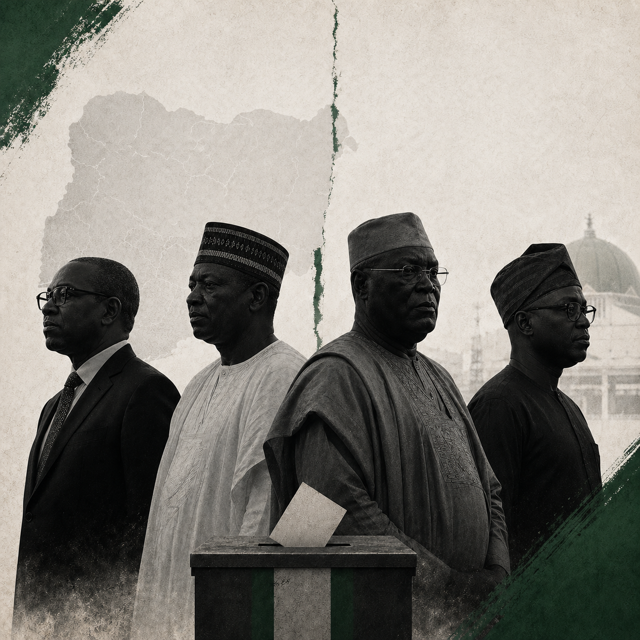
Executive summary The opposition can only unseat Tinubu in 2027 if it solves a coordination problem, not just a popularity problem. The numbers from 2023 show Tinubu won with 8.79 million votes, while Atiku and Obi split a much larger anti-APC bloc, and that fragmentation remains the central obstacle. Recent opposition moves toward a single candidate, plus talk of coalition-building around Atiku, Kwankwaso, Obi, Makinde, and the ADC platform, suggest the arithmetic is finally being taken seriously.
Historical vote pattern: Nigeria’s presidential elections have consistently rewarded broad coalitions and punished divided challengers. In 1999, turnout was 52.3 percent and Obasanjo won 62.78 percent to Falae’s 37.22 percent; turnout peaked in 2003 at 69.1 percent, then fell steadily to 57.5 percent in 2007, 53.68 percent in 2011, 43.65 percent in 2015, 34.75 percent in 2019, and 26.71 percent in 2023. In 2023, Tinubu took 36.61 percent, Atiku 29.07 percent, Obi 25.40 percent, and Kwankwaso 6.23 percent, which means the anti-Tinubu vote was numerically larger than his vote, but strategically broken.
Regional strength map: The opposition’s route is not national abstraction; it is state-by-state accumulation. APC remained strong in much of the southwest and parts of the northwest in 2023, while LP posted exceptional numbers in the southeast and parts of the south-south and north-central, and PDP retained pockets of strength in the southeast, south-south, and selected northern states. The key takeaway is that no opposition party alone has a national monopoly, but a merged ticket could combine PDP’s northern structure, Kwankasiya movement, LP’s urban youth base, and Makinde’s southwest credibility into a broader anti-incumbent map.
Polling and sentiment: Recent polling and approval data suggest Tinubu is vulnerable, but not doomed. One nationwide poll by EBDA placed his approval at 37.2 percent with 43.4 percent disapproval, while NOIPolls showed government approval slipping to 49 percent in February 2026 after stronger readings earlier in the year. That is not collapse, but it is weak enough to make incumbency contestable, especially if the opposition can convert dissatisfaction into turnout rather than just social-media anger.
Economic vulnerabilities: The administration’s biggest weakness is the cost of living. Inflation, insecurity, and weak purchasing power remain the most powerful anti-incumbent issues, and analysts say election-year spending and insecurity-linked disruptions could further worsen inflationary pressure and political risk. Opposition messaging should therefore centre on household pain: food prices, fuel costs, transport, unemployment, and insecurity, because those are the issues most likely to move undecided voters.
Coalition math: A viable coalition would need Atiku’s national network, Obi’s youth and urban appeal, and Makinde’s bridge-building value in the southwest. Atiku can still organize the PDP establishment, Obi can keep turnout high in cities and among first-time voters, and Makinde could reduce Tinubu’s Yoruba advantage by signalling that opposition against APC is not anti-Yoruba. The danger is ego: if each bloc wants the ticket rather than the strategy, APC wins through division.
Swing states: The most important swing states are Lagos, Oyo, Osun, Ogun, FCT, Plateau, Benue, Nasarawa, Delta, Rivers, Kano, Kaduna, Katsina, and Bauchi. Lagos and Oyo matter because of turnout and elite influence; Kano and Kaduna matter because of sheer vote volume; Plateau, Benue, Nasarawa, and the FCT can swing on protest voting; Rivers and Delta matter because of PDP/LP/APC competition; and Osun/Ogun are tests of southwest leakage from APC. In a close race, capturing even two or three of these battlegrounds could change the national outcome.
Voter mobilization: The opposition should focus on three tactics: ground game, voter protection, and message discipline. Ground game means ward-level organization, transport to polling units, and daily contact with voters; voter protection means accredited polling-unit agents, result collation parallel tracking, and BVAS/IREV monitoring; message discipline means one candidate, one narrative, one target. The biggest historical lesson since 1999 is that turnout has collapsed, so the side that best reactivates discouraged voters often beats the side with the loudest elite endorsements.
INEC reforms: The most important reform is stronger electronic result transmission and tighter enforcement of collation integrity. Opposition leaders have already pressed for reforms to the Electoral Act and better transmission safeguards, which is sensible because any coalition that cannot trust the count is building on sand. A clean register, transparent IREV access, fewer manual overrides, and stricter sanctions for result tampering would improve legitimacy and reduce post-election conflict.
Scenario estimates: Best case for the opposition: a single candidate, disciplined coalition, strong turnout in swing states, and credible election management. That gives the opposition a meaningful path to victory, roughly 45-55 percent if the coalition truly holds. Base case: partial alliance, some elite defections, but persistent fragmentation; then Tinubu remains favoured, roughly 55-65 percent. Worst case for the opposition: multiple candidates, identity politics, weak turnout, and disputed coalition discipline; then APC wins comfortably, around 70 percent or more.
Strategic verdict The opposition can beat Tinubu, but only by behaving like a government-in-waiting rather than a protest movement. The winning formula is simple to state and hard to execute: unite early, pick a candidate with cross-regional legitimacy, focus relentlessly on economic pain, and guard every polling-unit result. Without that, 2027 becomes another election where the opposition has the numbers in theory and the defeat in practice.