
Iyad ag Ghali’s Coalition and Goïta Brace for a Decisive Showdown in Mali
Mali is approaching one of the most consequential moments since the military seized power in 2020. The confrontation between Colonel Assimi Goïta’s junta and the jihadist coalition led by Iyad ag Ghali is no longer a distant insurgency confined to remote regions. It is evolving into a direct struggle over authority, legitimacy and the future shape of the Malian state.
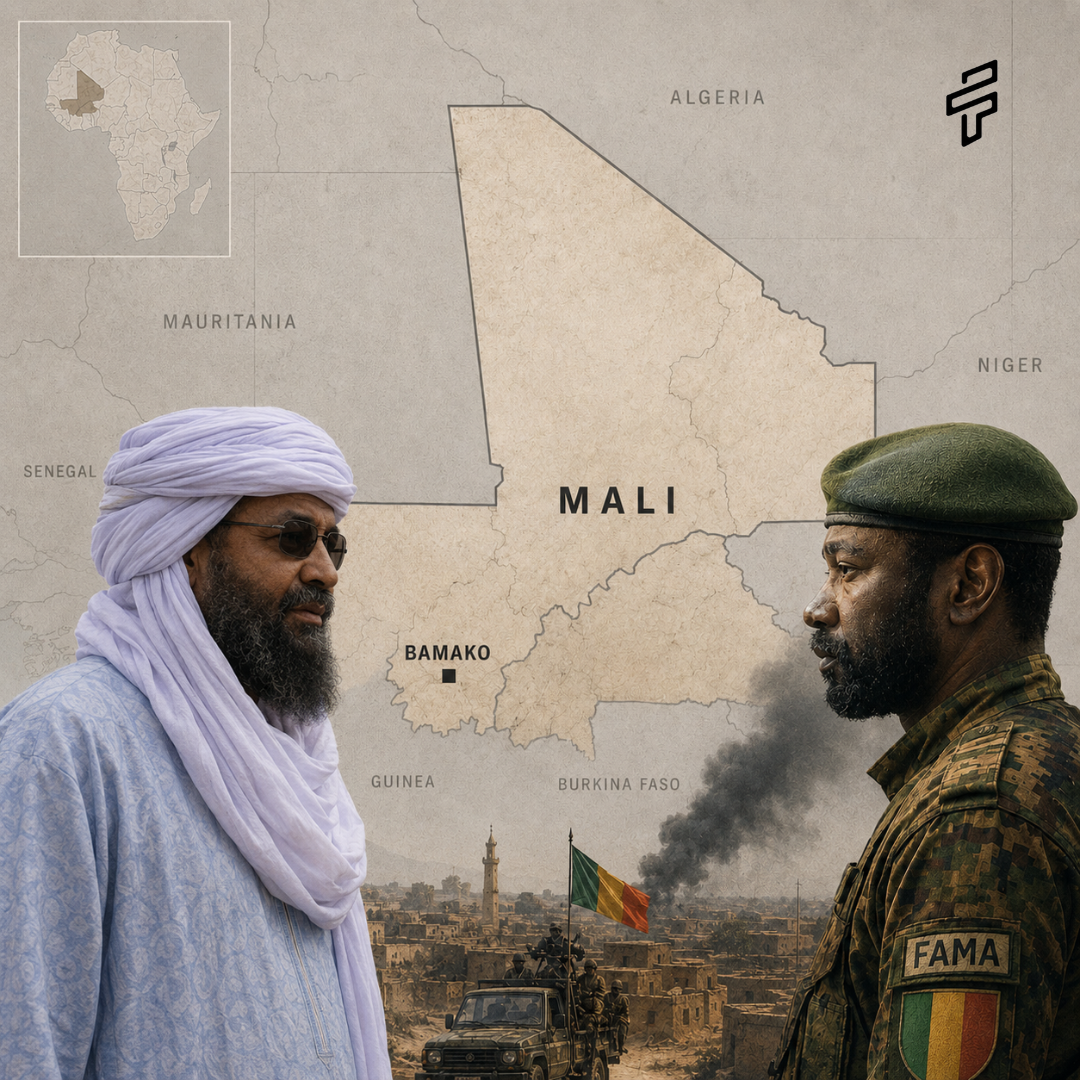
Mali is approaching one of the most consequential moments since the military seized power in 2020. The confrontation between Colonel Assimi Goïta’s junta and the jihadist coalition led by Iyad ag Ghali is no longer a distant insurgency confined to remote regions. It is evolving into a direct struggle over authority, legitimacy and the future shape of the Malian state.
For years, Mali’s conflict has been characterised by fragmentation. Military governments, separatist movements, local militias and jihadist organisations all competed for influence across vast territories where state authority was weak. Today, however, the battlefield is becoming increasingly polarised. On one side stands Goïta’s military regime, strengthened by Russian support and determined to reassert state control. On the other stands Jama’at Nusrat al-Islam wal-Muslimin (JNIM), the al-Qaeda-linked coalition led by Iyad ag Ghali, which has steadily expanded its reach across central and northern Mali.
The stakes extend far beyond military gains or losses.
Goïta has built his legitimacy around the promise of restoring sovereignty and defeating armed groups after years of frustration with international interventions. The departure of French forces and the reduction of Western influence were presented as turning points that would allow Mali to reclaim control of its security agenda. Success against jihadist forces is therefore central to the junta’s political credibility.
Yet JNIM has demonstrated remarkable resilience. Rather than seeking conventional territorial control alone, the coalition has embedded itself within local grievances, exploited governance failures and established influence across key rural areas. Its strategy combines military pressure with political outreach, allowing it to survive repeated counterinsurgency campaigns.
Recent attacks and expanding operational reach suggest that JNIM believes momentum is shifting in its favour. The group has increased pressure on military positions, transport routes and strategic towns, seeking to demonstrate that the state remains unable to guarantee security despite years of military rule.
This emerging showdown matters because it will help determine whether Mali’s current political model is sustainable. The junta has concentrated power, postponed democratic transition timelines and justified extraordinary measures through the language of national security. If security conditions continue to deteriorate, the regime’s central argument for remaining in power becomes increasingly vulnerable.
For Iyad ag Ghali, the confrontation is equally significant. JNIM does not need to capture Bamako to claim success. It only needs to convince communities, regional actors and international observers that the state cannot decisively defeat it. Every successful attack reinforces the perception that the movement remains a permanent political and military force despite years of counterterrorism efforts.
The struggle also carries regional implications. Mali sits at the centre of the Sahel crisis. Developments there affect Burkina Faso, Niger and neighbouring coastal states increasingly concerned about jihadist expansion. A major shift in the balance of power inside Mali could reshape security calculations across West Africa.
Another reason this contest deserves close attention is that it reflects a broader debate about governance in the Sahel. Military governments have argued that strong central authority is necessary to defeat insurgencies. Critics counter that military solutions alone cannot address the political, economic and social conditions that allow armed groups to recruit and expand. The outcome of the Goïta-ag Ghali confrontation will inevitably influence that debate.
In the short term, neither side appears capable of achieving a decisive victory. The Malian armed forces have improved their operational capabilities and retain control of major urban centres. Russian assistance continues to provide important support. However, JNIM maintains mobility, local networks and the ability to strike across multiple regions simultaneously.
The most likely near-term outcome is therefore an intensification of violence rather than a clear resolution. Military operations are likely to increase, strategic towns may face greater pressure and civilian populations could find themselves caught between competing forces. Both sides will seek symbolic victories that reinforce narratives of momentum.
A second possibility is that the conflict produces a political recalculation. If military pressure fails to deliver decisive results, discussions about local ceasefires, negotiations or informal arrangements could re-emerge, even if publicly denied by the authorities. Such outcomes would not end the conflict but could alter its trajectory.
What appears increasingly unlikely is a rapid restoration of state authority across all contested regions. The structural drivers of instability remain deeply entrenched, and neither military offensives nor jihadist advances have fundamentally changed that reality.
The coming months will therefore be critical. For Goïta, the challenge is proving that military rule can deliver the security improvements promised to Malians. For Iyad ag Ghali, the objective is demonstrating that his coalition remains the most potent challenger to state authority in the Sahel.
The significance of this power struggle lies not simply in who wins the next battle. It lies in what the confrontation reveals about the future of Mali itself. Whether the state can reassert control, whether jihadist influence continues to expand and whether a political settlement remains possible are questions that will shape not only Mali’s future but the wider trajectory of the Sahel.