
Sonko’s Speakership Turns Senegal’s Alliance of Victory Into a Rivalry of Power
Ousmane Sonko’s election as speaker of Senegal’s National Assembly is more than a parliamentary appointment. It is the clearest sign yet that the political alliance that brought President Bassirou Diomaye Faye to power has entered a new and unstable phase.
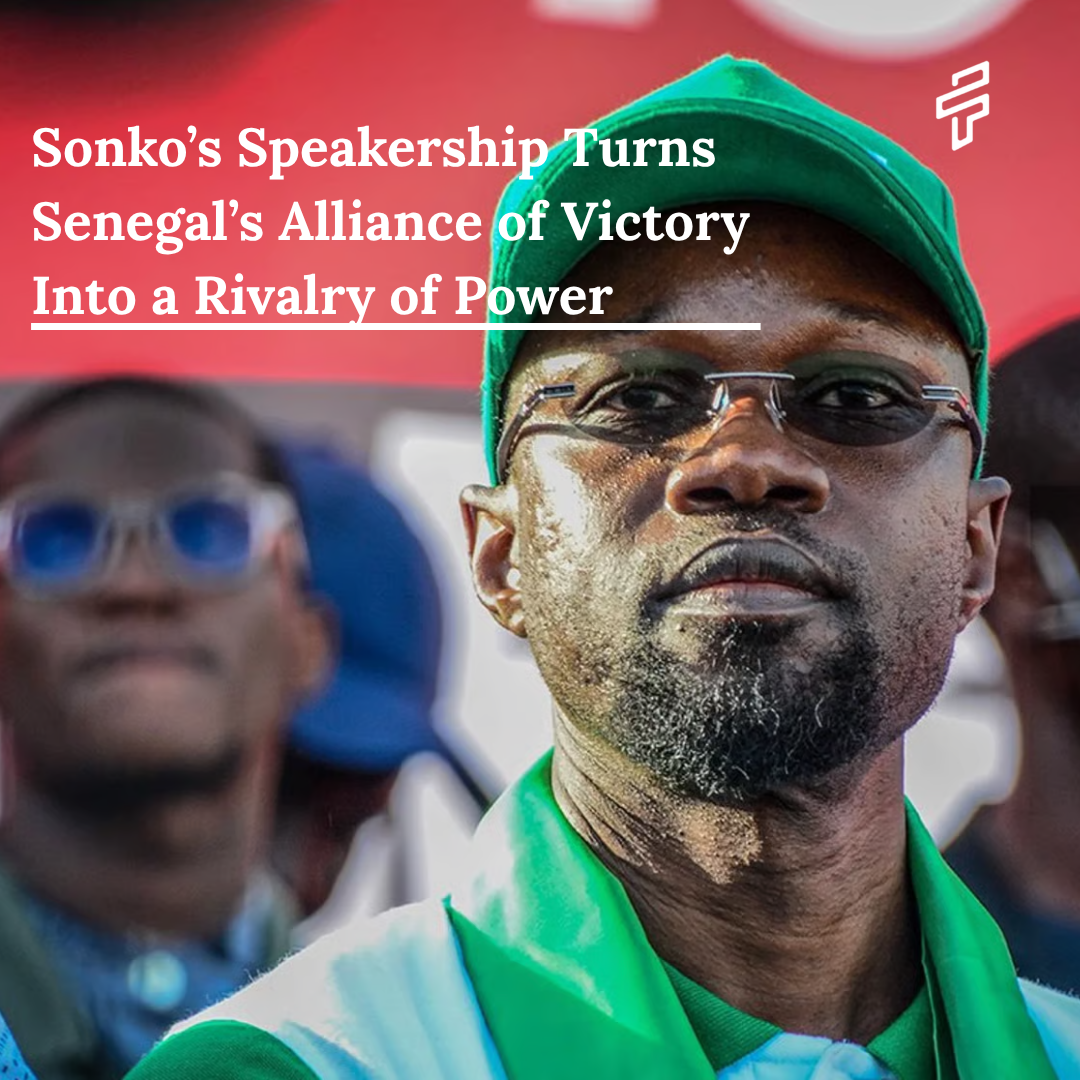
Ousmane Sonko’s election as speaker of Senegal’s National Assembly is more than a parliamentary appointment. It is the clearest sign yet that the political alliance that brought President Bassirou Diomaye Faye to power has entered a new and unstable phase.
Only two years ago, Faye and Sonko represented one of Africa’s most compelling opposition success stories. Sonko, the charismatic leader of Pastef, had been barred from the 2024 presidential race, while Faye, his close ally and political substitute, emerged from detention to win the presidency. Their victory was built on a promise of rupture: sovereignty, accountability, lower living costs, institutional reform and a cleaner break from the political order associated with Macky Sall.
That alliance has now fractured at the centre of the state.
Sonko was dismissed as prime minister by Faye in late May, after months of tension over economic policy, political authority and the direction of reform. Days later, the National Assembly elected him speaker. The vote was striking: Sonko received 132 votes out of 133 lawmakers present, in a parliament where Pastef holds a commanding majority. The opposition boycotted the process and questioned the legality of his return to the chamber, but the political message was unmistakable. Sonko may have lost the premiership, but he has not lost power.
The result creates an unusual dual centre inside Senegal’s ruling order. Faye controls the presidency and the executive. Sonko now controls the legislature and the ruling party’s activist base. This is not classical cohabitation between rival parties. It is more delicate: a split inside the movement that won power together.
The speaker’s office gives Sonko significant institutional leverage. He can shape the legislative calendar, influence debates, supervise parliamentary oversight and help determine whether the government’s economic programme moves smoothly or faces obstruction. In a country facing a serious debt crisis and delicate negotiations with the International Monetary Fund, that leverage matters.
Senegal’s economic position is already strained. A 2024 audit revealed previously unreported liabilities, damaging fiscal credibility and contributing to the suspension of an IMF programme. The government is now trying to negotiate a new path with international lenders. Faye’s new prime minister, Ahmadou Al Aminou Lo, is viewed as a more technocratic figure, and Finance Minister Cheikh Diba has been retained with expanded responsibility. This suggests that the presidency wants to reassure creditors and stabilise the economy.
Sonko’s instincts point in a different direction. His political identity has long been built around sovereignty, anti-corruption and suspicion of externally imposed economic discipline. He has criticised aspects of the IMF approach and has positioned himself as the guardian of the original Pastef mandate. From the speakership, he can argue that he is not sabotaging the government, but protecting the revolution from technocratic retreat.
This is where the tension with Faye becomes strategic. Faye’s presidency requires governability. He must manage debt, inflation, investors, foreign partners and Senegal’s reputation as one of West Africa’s more stable democracies. Sonko’s power depends on political mobilisation. He must maintain the energy of a movement that expected dramatic change after years of repression, protest and sacrifice.
The danger is that both men are right in different ways. Faye cannot govern Senegal through permanent agitation. Sonko cannot allow the reform project to be absorbed into cautious administrative management. But if they cannot establish a working division of power, Senegal risks paralysis at the very moment it needs fiscal clarity and institutional discipline.
The personal dimension is also difficult to ignore. Sonko was the original political star of Pastef. Faye became president because Sonko could not run. That history creates a structural ambiguity: who owns the mandate? Is Faye the sovereign president elected by the people, or the custodian of a political project whose emotional centre remains Sonko? The answer will determine how the next stage of Senegalese politics unfolds.
As speaker, Sonko now has a platform from which to monitor, pressure and potentially challenge the executive. He has said his role should not be used for revenge, but the institutional incentives point toward confrontation. If the presidency moves toward IMF-backed reforms that Sonko’s base considers a betrayal, parliament could become the arena of resistance.
There is also a longer-term question: 2029. Sonko’s political future remains tied to whether he can present himself as the authentic bearer of the Pastef project. Faye, already president, may seek to consolidate his own authority beyond the shadow of his former mentor. Their rivalry is therefore not only about today’s cabinet or parliament. It is about succession, legitimacy and who defines Senegal’s political transformation.
For now, Senegal has avoided institutional collapse. The army is not the arbiter, the courts are still relevant, and parliament is functioning. That matters in a region where democratic stress often takes more dangerous forms. But Senegal’s stability has always rested on political restraint as much as formal procedure.
Sonko’s election as speaker has not ended the crisis. It has constitutionalised it. The rivalry has moved from the executive palace into the legislature, where it will now shape budgets, reforms and the country’s economic negotiations.
The central question is no longer whether Faye and Sonko can recreate the alliance that brought them to power. It is whether they can disagree without breaking the state they promised to rebuild.