
China’s Zero-Tariff Africa Push Tests Trade Politics as Eswatini Is Left Out
Beijing’s tariff-free access for 53 African countries strengthens its economic diplomacy, but the exclusion of Eswatini shows how trade, recognition and geopolitics remain tightly linked.
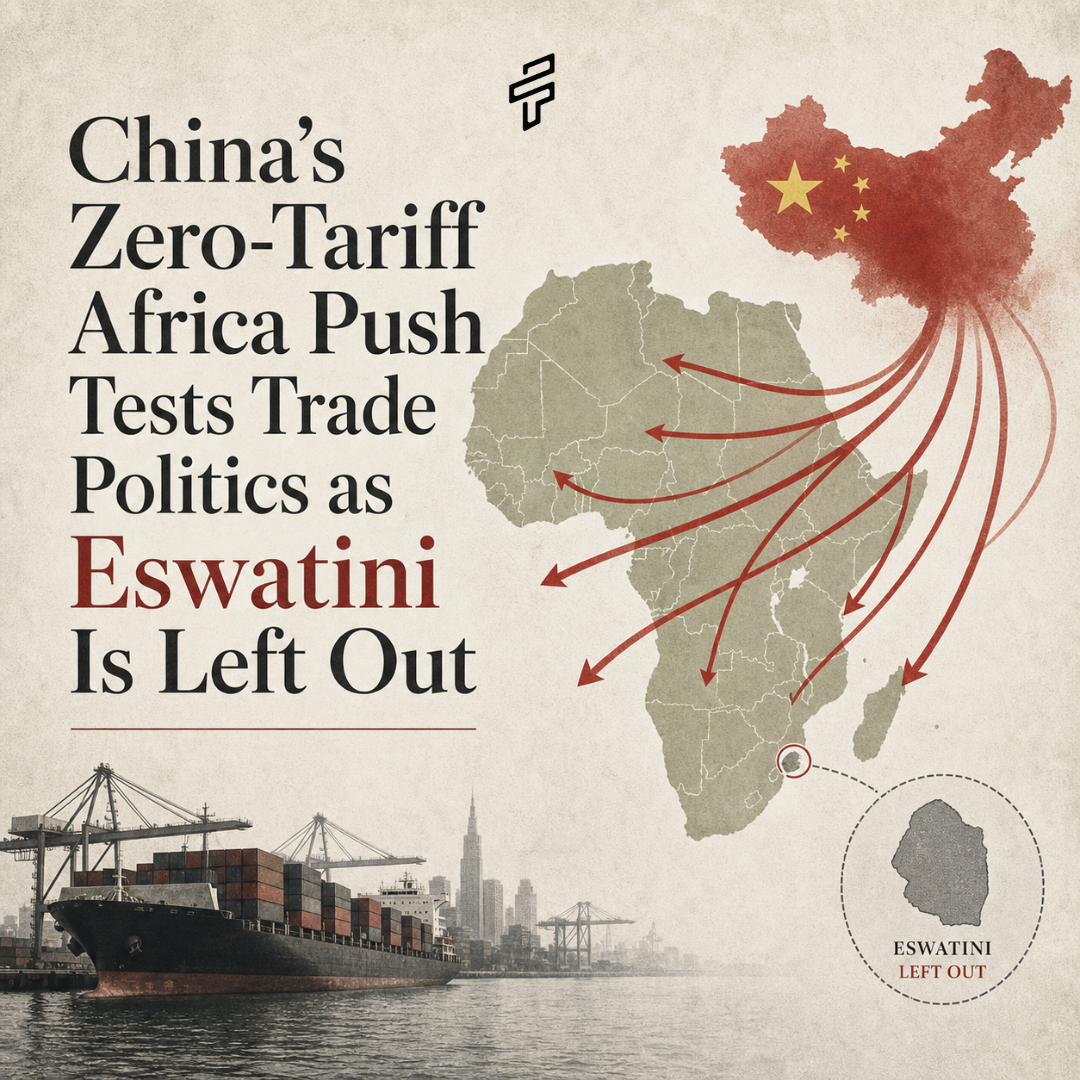
China has begun implementing a policy granting tariff-free access to imports from Africa’s biggest economies and, more broadly, the 53 African countries that maintain diplomatic relations with Beijing. AP reported that the policy came into effect on Friday, 1 May 2026, at a time when the United States is moving toward more protectionist trade measures.
The policy excludes Eswatini, which remains Taiwan’s only formal diplomatic ally in Africa. That exclusion makes the measure more than a commercial incentive. It is also a reminder that China’s Africa strategy operates through a combination of trade access, infrastructure finance, diplomatic pressure and recognition politics.
South Africa and Kenya have backed China’s zero-tariff push, according to Africanews reporting based on AP. For African exporters, the policy could create new opportunities in agriculture, minerals, manufacturing and processed goods. The question is whether African economies can use the access to move beyond raw commodity exports into higher-value production.
The timing is important. African countries are facing a difficult global trade environment shaped by high borrowing costs, energy volatility and renewed tariff politics. Beijing’s offer gives China a diplomatic contrast with Washington, presenting itself as an open market for African goods while the U.S. pushes a more restrictive agenda.
But tariff-free access does not automatically create industrial transformation. African producers still face logistics constraints, standards requirements, weak processing capacity and uneven export finance. The real test will be whether governments can convert preferential access into jobs, value addition and stronger bargaining power.
Eswatini’s exclusion adds a sharper diplomatic edge. Taiwan’s President Lai Ching-te arrived in Eswatini on 2 May after a delayed trip that Taiwan blamed on Chinese pressure over flight permissions. Eswatini’s place in this story is therefore symbolic: a small African monarchy sitting at the intersection of China’s continental influence and Taiwan’s shrinking diplomatic space.
China’s offer may prove commercially useful. But its political message is equally clear: in Africa’s trade diplomacy, market access and recognition are increasingly being negotiated together.