
Mali Accuses Soldiers of Aiding Jihadists as Sahel Crisis Reaches Bamako’s Doorstep
Bamako’s claim that military officers helped coordinate recent attacks marks a dangerous new stage in Mali’s war, where insurgent pressure, army cohesion and Russian-backed security strategy are now all under scrutiny.
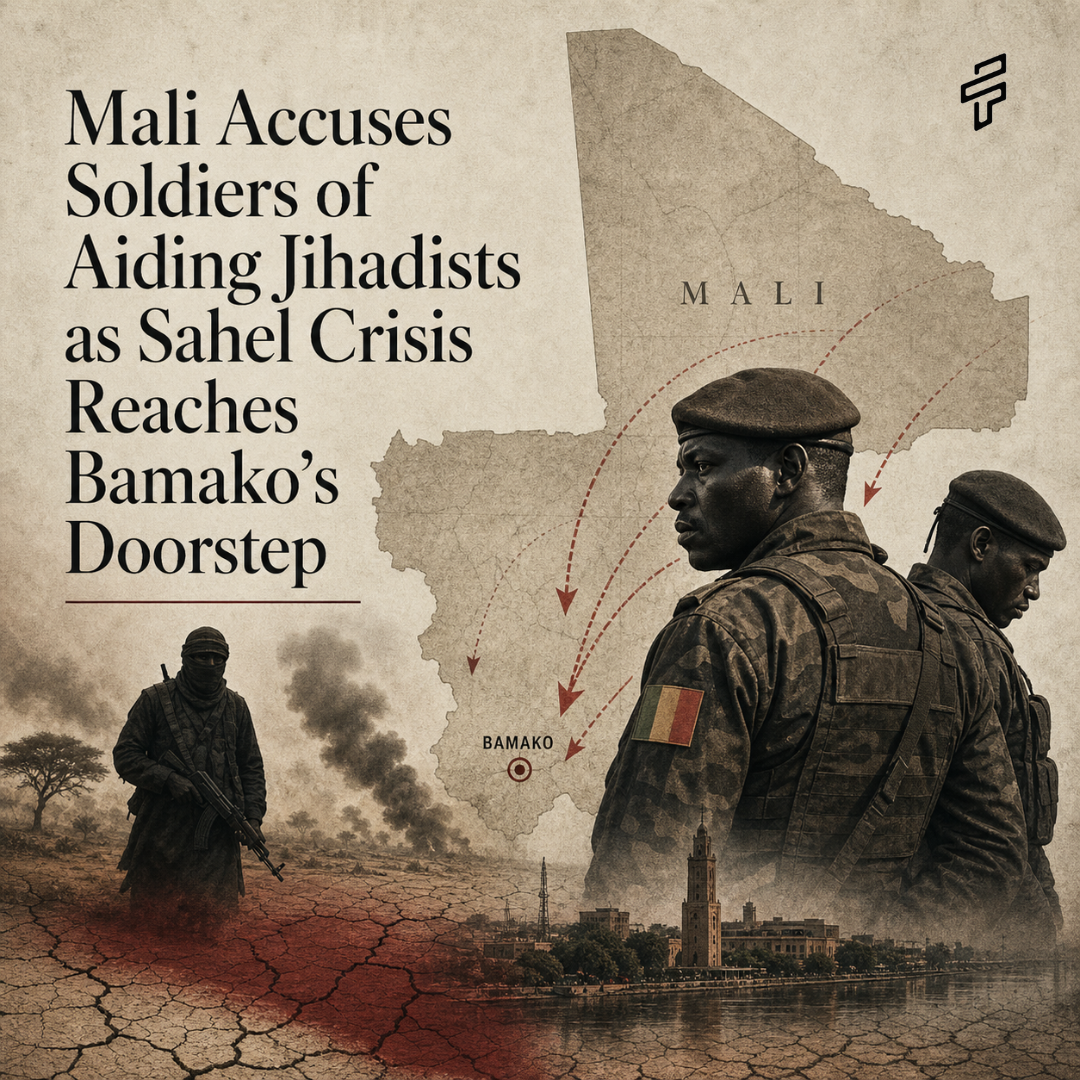
Mali’s military government has accused some serving and dismissed officers of working with jihadist and separatist groups to carry out the recent wave of coordinated attacks that struck across the country. The accusation follows one of the most serious escalations in Mali’s conflict in more than a decade, including attacks linked to al-Qaeda-affiliated Jama’at Nusrat al-Islam wal-Muslimin and the Azawad Liberation Front.
The attacks were significant because of both their scale and their location. Armed groups targeted sites including Bamako’s international airport, military installations and northern towns, while Mali’s defence minister, Sadio Camara, was killed during the wider assault. Reuters reported that the attacks exposed the growing reach and coordination of militants across West Africa, with fighters able to strike at the centre of a military government that has promised restored security.
The government’s allegation of internal collaboration raises the stakes. Mali’s military prosecutor said evidence indicated the involvement of active and dismissed officers, as well as exiled politician Oumar Mariko. For a junta built on claims of discipline, sovereignty and security competence, the suggestion of insider assistance cuts into the political foundation of military rule.
The territorial picture is also troubling. Armed groups have reportedly taken or threatened strategic locations including Kidal and Tessalit, while militants have imposed pressure around Bamako through blockades and road insecurity. This suggests that Mali’s crisis is not contained in the north; it is now pressing against the political centre.
Russia’s role remains central to the story. Mali’s junta expelled French forces and turned to Moscow-backed security support, but recent setbacks have damaged Russia’s image as a security guarantor in the Sahel. Reuters reported that the insurgent offensive threatens Russian strategic and economic interests in Africa, while earlier reporting said Russian-linked forces suffered casualties during the fighting.
The broader regional concern is that Mali’s conflict is becoming more connected, more mobile and more politically destabilising. Reuters reported that militant influence now stretches across a vast belt from western Mali through Niger, Burkina Faso and toward Nigeria and Chad, threatening mining operations, transport corridors and coastal West African states.
Bamako may respond with arrests, curfews and a harder military campaign. But the deeper problem is structural. If the army cannot guarantee internal loyalty, if Russian-backed forces cannot hold strategic areas, and if armed groups can pressure the capital, Mali’s war has moved into a more dangerous political phase.