
Taiwan’s President Lands in Eswatini as China Pressure Sharpens Africa Diplomacy
Taiwan’s president has arrived in Eswatini, its only African diplomatic ally, after a delayed trip that Taipei linked to Chinese pressure.
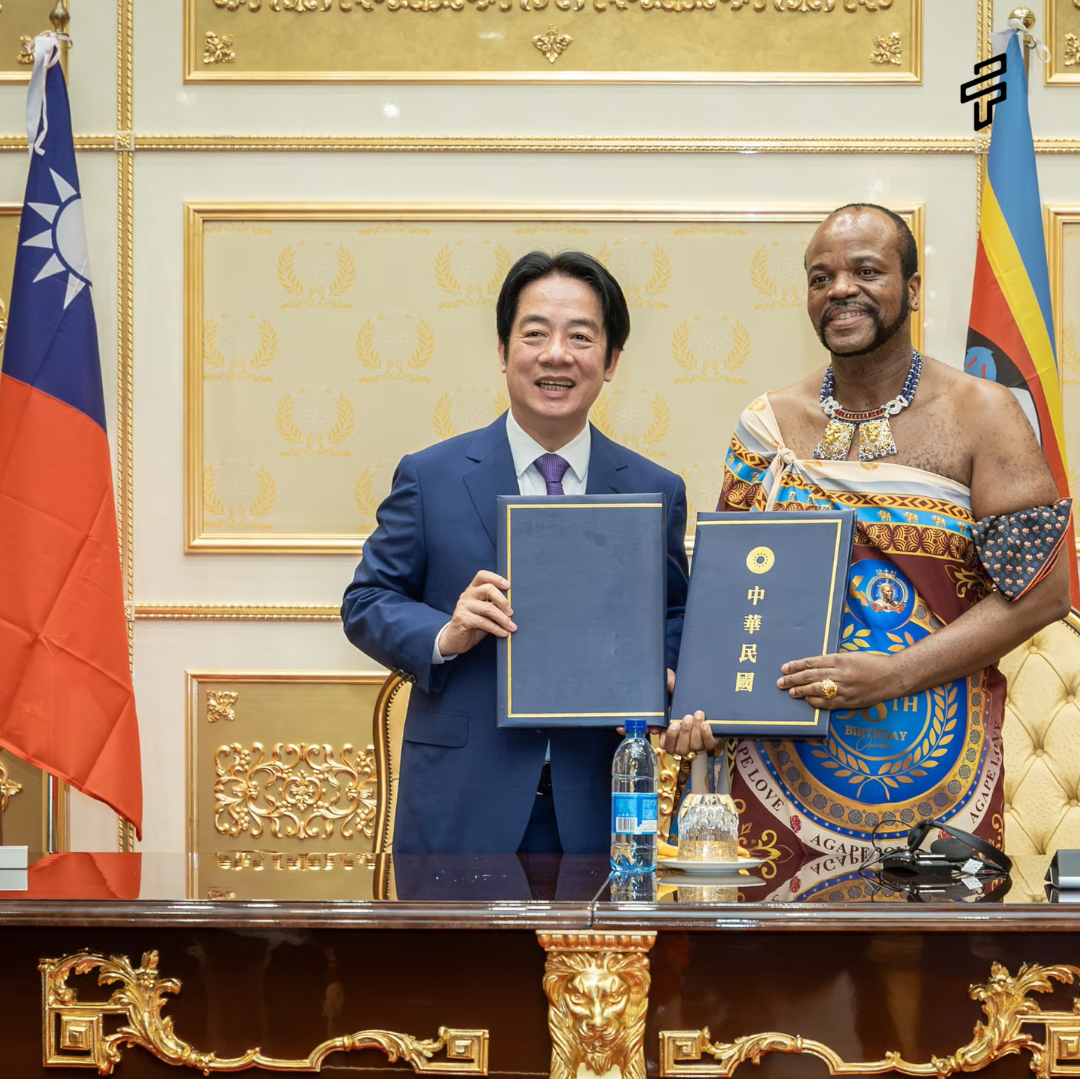
Taiwanese President Lai Ching-te arrived in Eswatini on Saturday after a previous trip was delayed by denied or revoked flight permissions from Seychelles, Mauritius and Madagascar. Taiwan blamed Chinese pressure for the disruption, while Beijing criticised Lai’s visit and repeated its claim that Taiwan is part of China.
Eswatini is Taiwan’s only formal diplomatic ally in Africa and one of only 12 states worldwide that still maintain formal relations with Taipei. That makes the kingdom disproportionately important in Taiwan’s foreign policy, especially as Beijing continues to narrow Taiwan’s diplomatic space.
The visit was reportedly disclosed only after Lai had arrived, reflecting the sensitivity of travel planning under diplomatic pressure. Reuters reported that Lai travelled on what appeared to be an Eswatini government aircraft, avoiding public details about his route.
The timing is striking because China’s expanded zero-tariff policy for African countries has just come into effect, excluding Eswatini because it does not recognise Beijing. This means Eswatini is now both Taiwan’s last African diplomatic partner and the only African country outside China’s new continental trade access offer.
The pressure has also moved beyond state visits. AP reported that the RightsCon human rights summit planned for Zambia was cancelled after alleged Chinese pressure to exclude Taiwanese activists, according to organiser Access Now. Zambia said the postponement was tied to national values and interests, but the episode reinforced concerns that Taiwan-related diplomacy is increasingly shaping civil society spaces in Africa.
For Eswatini, the diplomatic value of remaining with Taiwan may include development cooperation, visibility and direct bilateral support. But the costs are rising. Exclusion from China’s tariff-free framework and Beijing’s wider influence across Southern Africa will keep testing Mbabane’s calculation.
The visit shows that Africa is not a passive stage in the China-Taiwan dispute. African governments are making choices, absorbing pressure and weighing the costs of recognition in a more competitive geopolitical environment.