
Washington’s Africell bet shows that Africa’s telecom networks are becoming strategic infrastructure
The United States has approved a $99.6m loan to Africell, the only American-owned telecommunications company with a substantial consumer presence in Africa. The financing will…
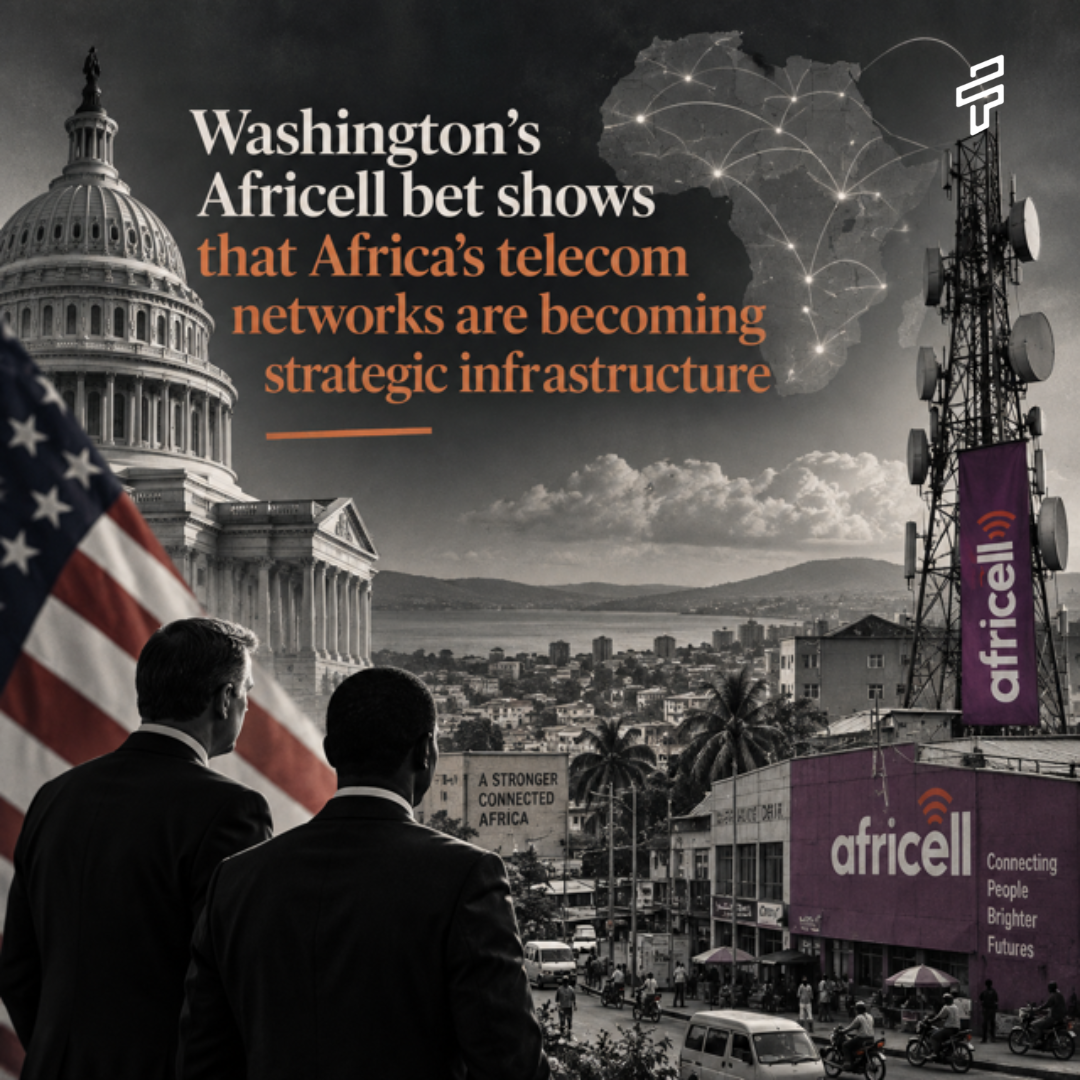
The United States has approved a $99.6m loan to Africell, the only American-owned telecommunications company with a substantial consumer presence in Africa. The financing will support network expansion in Angola and the use of American and allied technology, while Africell already operates across Angola, the Democratic Republic of Congo, Sierra Leone and The Gambia, serving around 15m customers.
Washington has made little secret of the strategic purpose. The investment is intended to provide an alternative to China's Huawei, which Reuters reports holds roughly 52% of Africa's 5G infrastructure market. Huawei rejects US allegations about security risks, while Beijing has accused Washington of politicising a commercial and technological relationship.
For African governments, however, the calculation is less ideological.
They need reliable connectivity, lower data costs and networks that can reach beyond major cities. They also need financing, and Chinese suppliers have built a strong position partly because they have been able to offer infrastructure on competitive terms and deploy it quickly.
That leaves African states with an opportunity that should not be overlooked. The stronger the competition among foreign suppliers, the greater the potential bargaining power of African governments — provided they use it to negotiate for local employment, technical training, cybersecurity standards, data protection and domestic ownership rather than simply choosing one geopolitical camp over another.
This distinction matters because replacing Chinese equipment with American equipment does not automatically create technological sovereignty. A country remains dependent if its hardware, software, financing and technical expertise all come from elsewhere.
The more consequential question is what infrastructure and expertise remain after the investment has been made.
That becomes particularly important as mobile networks feed into a much wider digital economy. Telecom infrastructure now supports mobile banking, public services, digital identity, cloud computing and increasingly artificial-intelligence applications. Whoever operates the network sits close to a system through which enormous quantities of personal and commercial data move.
As those systems become more sophisticated, telecommunications will be treated increasingly as critical infrastructure.
The geography of Africell's operations gives the deal additional significance. Angola is attempting to diversify from hydrocarbons; the DRC is central to the global critical-minerals economy; Sierra Leone and The Gambia occupy strategic positions on the Atlantic coast. A company operating across such markets provides Washington with relationships that extend beyond telecoms into the broader digital economy.
China has spent years building precisely these kinds of relationships.
The American response is therefore not simply a commercial investment. It is part of an effort to rebuild strategic influence in sectors where Beijing has established an early lead.
African governments should welcome the competition without allowing themselves to become the terrain on which the competition is decided.
Their strongest position would be to insist that external investment produces domestic capability. That means training African engineers, strengthening independent regulators and requiring clear rules around data access and infrastructure ownership.
The stakes are likely to rise as artificial intelligence becomes a larger component of economic policy. AI development requires reliable connectivity, data infrastructure, computing power and electricity. States that fail to build those foundations may become large consumers of AI services while capturing little of the value created by them.
The Africell deal is therefore best understood not as a telecom announcement but as an early contest over the architecture of Africa's digital economy.
The central question is not whether the hardware comes from America or China.
It is who ultimately controls the system.