
Nigeria’s security crisis is becoming a test of whether the state can protect its rural population
Nigeria’s security crisis has returned to the centre of national politics after armed men abducted what residents estimate to be around 600 women, children and older people from…
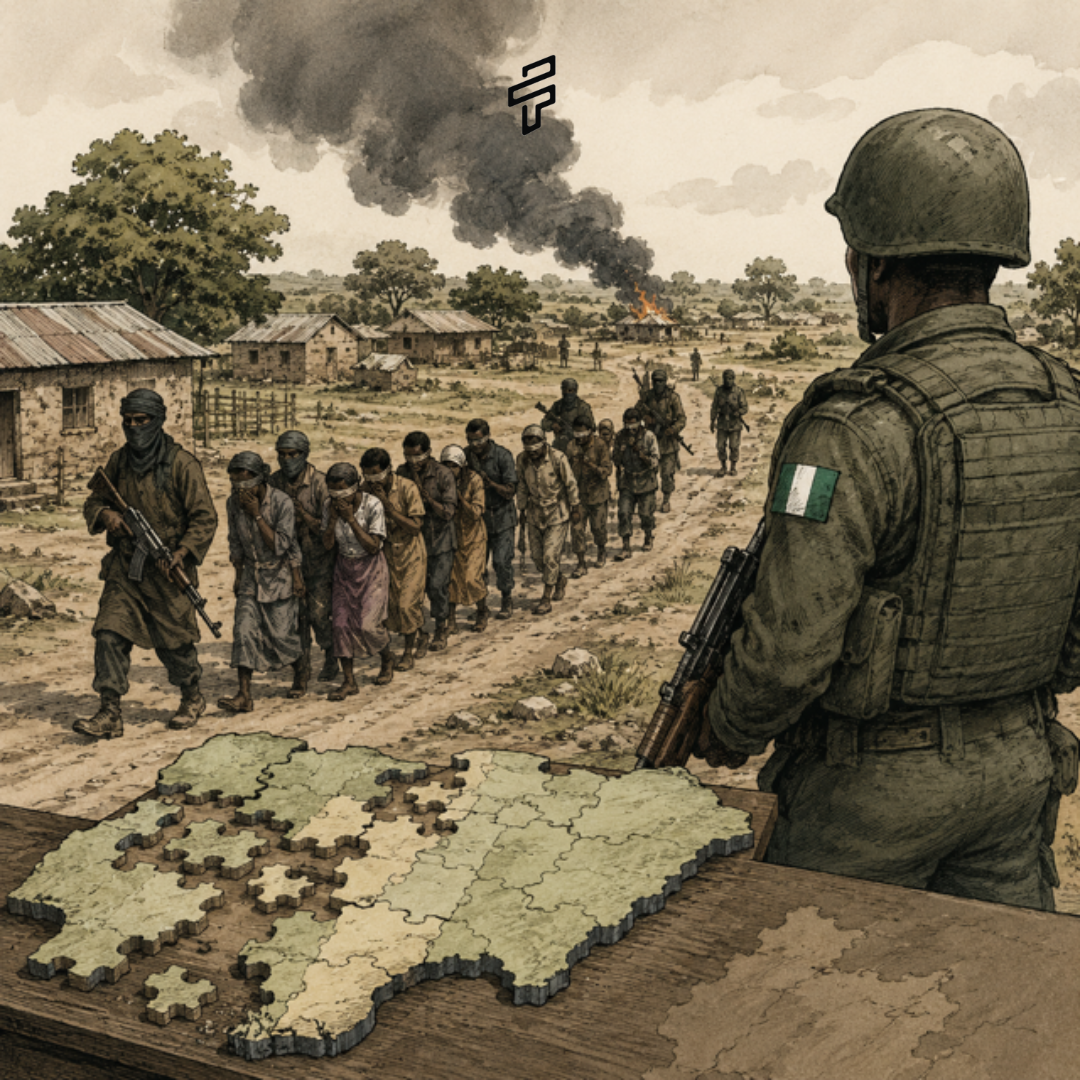
Nigeria’s security crisis has returned to the centre of national politics after armed men abducted what residents estimate to be around 600 women, children and older people from communities in north-central Niger State. The attackers also killed about 30 people and sent roughly 2,000 residents fleeing towards neighbouring Benin Republic, according to local officials and residents. President Bola Tinubu has ordered the military and other security agencies to launch a rescue operation and provide regular updates on the effort to locate those taken. Reuters could not independently verify the figure of 600, but if confirmed, the abduction would rank among Nigeria’s largest mass kidnappings in recent years.
The scale of the incident is striking. Its geography is more important still. The communities affected are in Niger State’s Borgu area, close to Nigeria’s western border, where dense bush, difficult roads and limited state presence provide armed groups with room to operate and move. The attackers were able to strike several communities, seize large numbers of civilians during Friday prayers and disappear into territory that security forces have struggled to control. That makes the episode more than another kidnapping incident. It is evidence of how much operational freedom armed groups can still exercise in parts of Nigeria.
Nigeria has been fighting several security conflicts at the same time for more than a decade. Boko Haram and Islamic State West Africa Province remain active in the northeast, while heavily armed criminal gangs operate across the northwest and north-central regions. Kidnapping for ransom has developed into a substantial criminal economy, while separatist violence continues to pose a security challenge in the southeast. These conflicts have different origins and organisations, but they increasingly overlap in the weaknesses they exploit: difficult terrain, porous borders, limited policing and communities that can remain outside consistent government protection.
The Niger State attack is particularly revealing because it demonstrates what organised kidnapping now requires. Abducting hundreds of people is not an opportunistic crime carried out by a few gunmen. It requires information about the target area, transport, weapons, food, communications, a secure place to hold captives and confidence that security forces will not arrive quickly enough to prevent the operation. Nigerian authorities are still investigating who carried out the attack and whether the perpetrators have links to jihadist organisations or operate primarily as criminal networks. That uncertainty is itself significant because the traditional distinction between terrorism and criminality is becoming increasingly difficult to maintain.
Criminal groups and militant organisations operate within the same wider security environment. Armed gangs can obtain weapons through regional trafficking networks, cooperate with more ideological groups and use ransom payments to finance wider criminal activity. Militants can also exploit the same forests and rural corridors used by kidnappers. What emerges is not a single insurgency but an ecosystem of armed groups that can move, cooperate and adapt faster than the institutions attempting to contain them.
The economics of kidnapping help explain why that ecosystem has proved so resilient. Armed groups do not need to defeat the Nigerian military to succeed. They need only to make themselves difficult enough to reach that families, businesses and communities begin treating ransom payments and displacement as unavoidable costs of survival. A recent SBM Intelligence report cited by Reuters estimated that 7,825 people were kidnapped in Nigeria between July 2025 and June 2026, while kidnappers collected about $5.79 million in recorded ransom payments. The researchers described the figures as conservative because many payments go unreported.
That turns kidnapping into more than a law-and-order problem. It becomes a self-reinforcing business model. Every successful abduction demonstrates that kidnapping can generate money. Every ransom payment provides an incentive for another operation. And every community that feels abandoned by the authorities becomes more vulnerable to extortion, recruitment and displacement.
The government therefore faces a harder task than simply rescuing those already taken. It has to make kidnapping less profitable and more difficult to organise in the first place. That means stronger intelligence networks, financial investigations into ransom flows, tighter control of arms trafficking, better rural policing and a justice system capable of prosecuting those involved. The military can disrupt an armed camp or rescue captives, but neither action necessarily dismantles the wider network that made the kidnapping possible.
The weakness is particularly visible in rural areas. Nigeria is one of Africa’s largest countries by population and territory, and its security institutions cannot maintain the same physical presence everywhere. Major cities contain police commands, military facilities and intelligence infrastructure. In remote communities, the state may be represented by a small police post, a local administrator or, in some cases, nobody at all. Armed groups understand this geography. Their advantage often comes not from superior firepower but from knowing where the state is absent.
That absence has consequences beyond security. Rural communities depend on safe roads to move agricultural goods, children need to reach schools, farmers need to reach fields and families need to attend places of worship without calculating whether doing so could make them targets. When people begin avoiding markets, abandoning farms or leaving entire communities, insecurity starts to weaken the local economy as well as physical security.
It also makes intelligence harder to obtain. Local residents are often the first people to notice unfamiliar armed men, unusual movements or the construction of temporary camps. But intelligence depends on trust. Communities that fear retaliation from armed groups or believe that reporting information will not result in protection have little incentive to cooperate with security forces. The result is a damaging cycle in which weak state presence produces weak intelligence, weak intelligence allows armed groups to operate more freely, and successful attacks further undermine confidence in the state.
For Tinubu, the political consequences are becoming harder to avoid. Security is likely to remain one of the government's central vulnerabilities as Nigeria approaches the 2027 presidential election. The administration can point to increased military spending, security operations and successful rescues, but the public experience of insecurity is measured in much simpler terms: whether people can travel, farm, attend school or worship without being kidnapped.
That is why the Niger State attack matters politically even if the victims are eventually rescued. A successful operation would demonstrate that the government can respond to a major security breach. It would not answer the harder question of why such an operation was possible in the first place.
The cross-border dimension makes that question wider than Nigeria. The movement of civilians towards Benin after the attacks illustrates how quickly insecurity can become a regional issue. Northern Nigeria sits within a broader West African security environment in which armed groups, weapons and criminal networks move across borders that are difficult to monitor consistently. Nigeria’s neighbours are already confronting instability of their own, while regional cooperation is under strain from the broader deterioration of security across the Sahel.
Nigeria cannot become significantly less secure without affecting those around it. Large-scale displacement places pressure on neighbouring communities, while porous borders can give armed groups additional routes for movement, recruitment and concealment. The response therefore requires more than Nigerian military operations. It requires intelligence sharing, border coordination and cooperation with neighbouring governments that face many of the same trafficking and insurgency networks.
The immediate priority is the safe recovery of the abducted civilians and a clear understanding of who carried out the attack. But the more important test will come afterwards. Nigeria has repeatedly demonstrated that it can mobilise security forces after a major attack. Its harder challenge is maintaining enough intelligence, policing and government presence in vulnerable areas to make those attacks harder to organise in the first place.
The Niger State kidnapping has therefore exposed a problem that cannot be solved by a single rescue operation. Nigeria’s security crisis is increasingly about territorial access: who can move through the country, who can control remote areas and who can provide protection when the state is not physically present.
The government can continue responding to attacks one by one. But until it can make large parts of rural Nigeria consistently inaccessible to armed groups, every successful rescue will risk becoming preparation for the next kidnapping rather than evidence that the underlying security problem has been solved.