
Nigeria’s suspension of parliamentary ties with South Africa raises the cost of a worsening migrant dispute
Nigeria's parliament has indefinitely suspended official visits to South Africa and participation in South African legislative events because of continuing attacks on Nigerians…
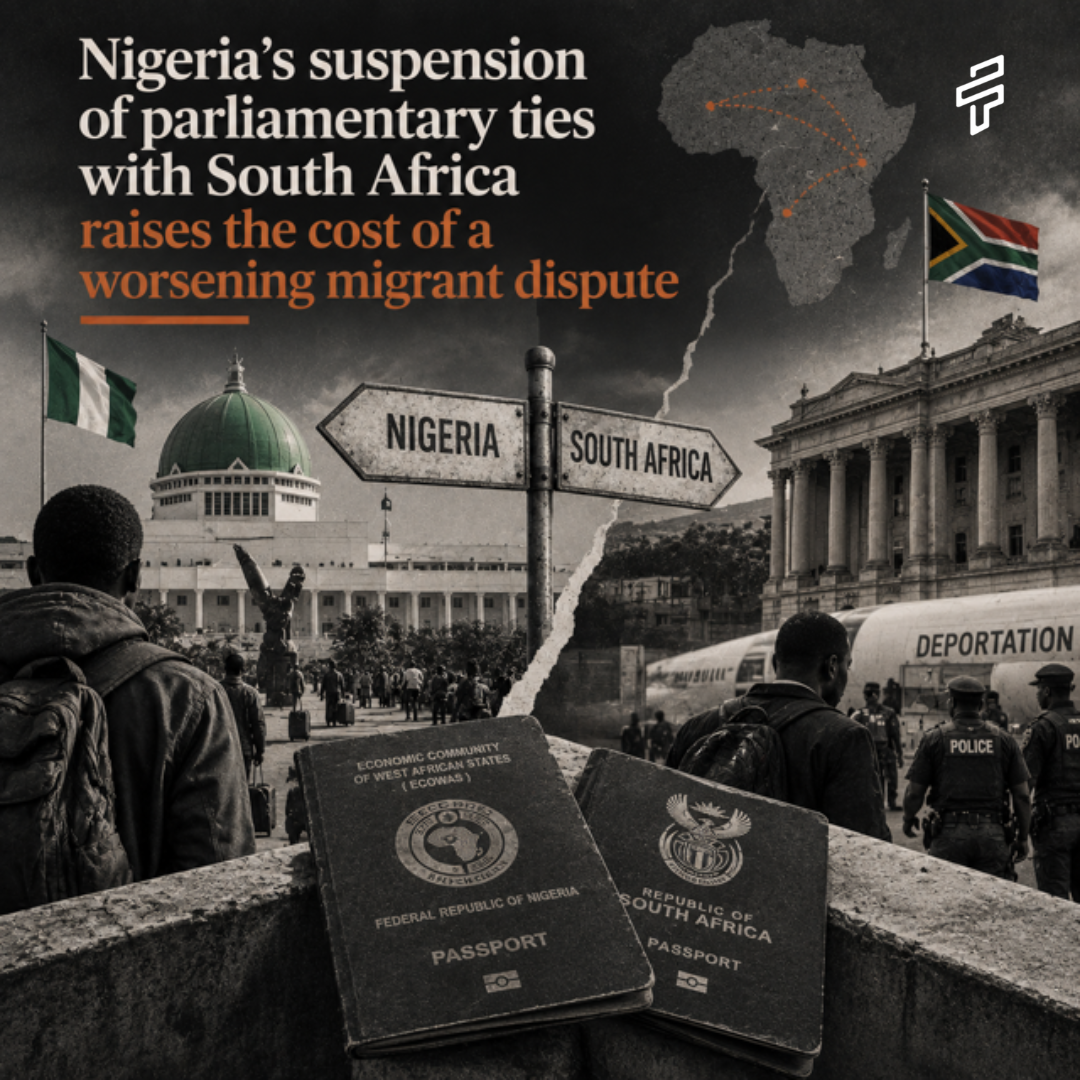
Nigeria's parliament has indefinitely suspended official visits to South Africa and participation in South African legislative events because of continuing attacks on Nigerians and other African migrants. The decision follows a series of violent incidents and comes after months of diplomatic concern over anti-migrant sentiment in South Africa.
Nigeria's response is unusually significant because the relationship between the two countries has long carried political weight across the continent. Both are among Africa's largest economies and most influential diplomatic actors, and both have played important roles in continental institutions and regional diplomacy.
The immediate dispute, however, is about the safety of Nigerians living and working in South Africa.
According to Diplomatic officials, 98 Nigerians have died in mob, hate-related or extrajudicial attacks in South Africa since 2022. Nigeria's government has also said 1,695 Nigerians voluntarily returned home during 2026 as concerns over their safety increased. Those figures come from Nigerian authorities and should be treated accordingly.
The latest parliamentary action is not a diplomatic rupture, but it is a clear escalation.
Nigeria has previously relied on bilateral dialogue to address anti-migrant attacks. South African officials have repeatedly condemned xenophobia and engaged Nigerian counterparts, including a July visit to Abuja by Foreign Minister Ronald Lamola. Yet the persistence of violence is making assurances harder to sustain politically.
The underlying problem is structural.
South Africa's extremely high unemployment and persistent inequality have created fertile ground for political movements that blame foreign nationals for competition over jobs, housing and public services. That argument is often presented as economic common sense, but it simplifies problems whose roots lie in the country's labour market, municipal governance and long-term structural inequality.
Migrants become a visible target for frustrations that are much harder to resolve through economic policy.
The cost, however, is not confined to migrants.
South African businesses depend on regional labour and cross-border trade, while Nigerian entrepreneurs and professionals have built longstanding commercial networks in South Africa. Every wave of violence makes those relationships more expensive and less predictable.
The diplomatic damage is also accumulating.
Nigeria's decision to suspend parliamentary engagement signals that the issue has moved from consular concern into the political relationship itself. That makes future disputes more likely to trigger official retaliation rather than quiet diplomatic management.
There is a regional dimension too. South Africa is home to large communities from Zimbabwe, Mozambique, Malawi, Nigeria and other African countries. If anti-migrant politics becomes more entrenched, the consequences could be felt throughout southern Africa through migration patterns, labour markets and bilateral relations.
Yet the solution cannot simply be to condemn xenophobia.
South Africa's government must enforce the law against attacks while addressing the political conditions that make anti-migrant mobilisation attractive. Nigeria, for its part, has to protect its citizens while keeping the bilateral relationship functional.
Neither government benefits from a permanent deterioration.
The economic relationship is too important, and the diplomatic relationship is too consequential.
That is why the parliamentary suspension should be understood as a warning rather than an endpoint.
If attacks continue, pressure for stronger measures from Abuja is likely to increase. If Pretoria can demonstrate effective protection for foreign nationals and distinguish legitimate immigration enforcement from collective scapegoating, the relationship can begin to recover.
For now, the dispute offers a broader lesson for African integration.
The free movement of people is central to continental trade and economic mobility. It cannot work if citizens move across borders believing that their safety depends on whether local politics happens to be calm.