
Nigeria’s fake-agency scandal raises questions the government has yet to answer.
Nigeria’s latest corruption scandal would almost be comic if its implications were not so serious. An alleged fraudster created a government agency that did not exist, presented himself as its director-general, obtained office space inside the Federal Secretariat in Abuja and interacted with government officials and foreign diplomats. The organisation maintained a government-style website and even appeared in Nigeria’s 2026 federal budget with an allocation of N1.3 billion.
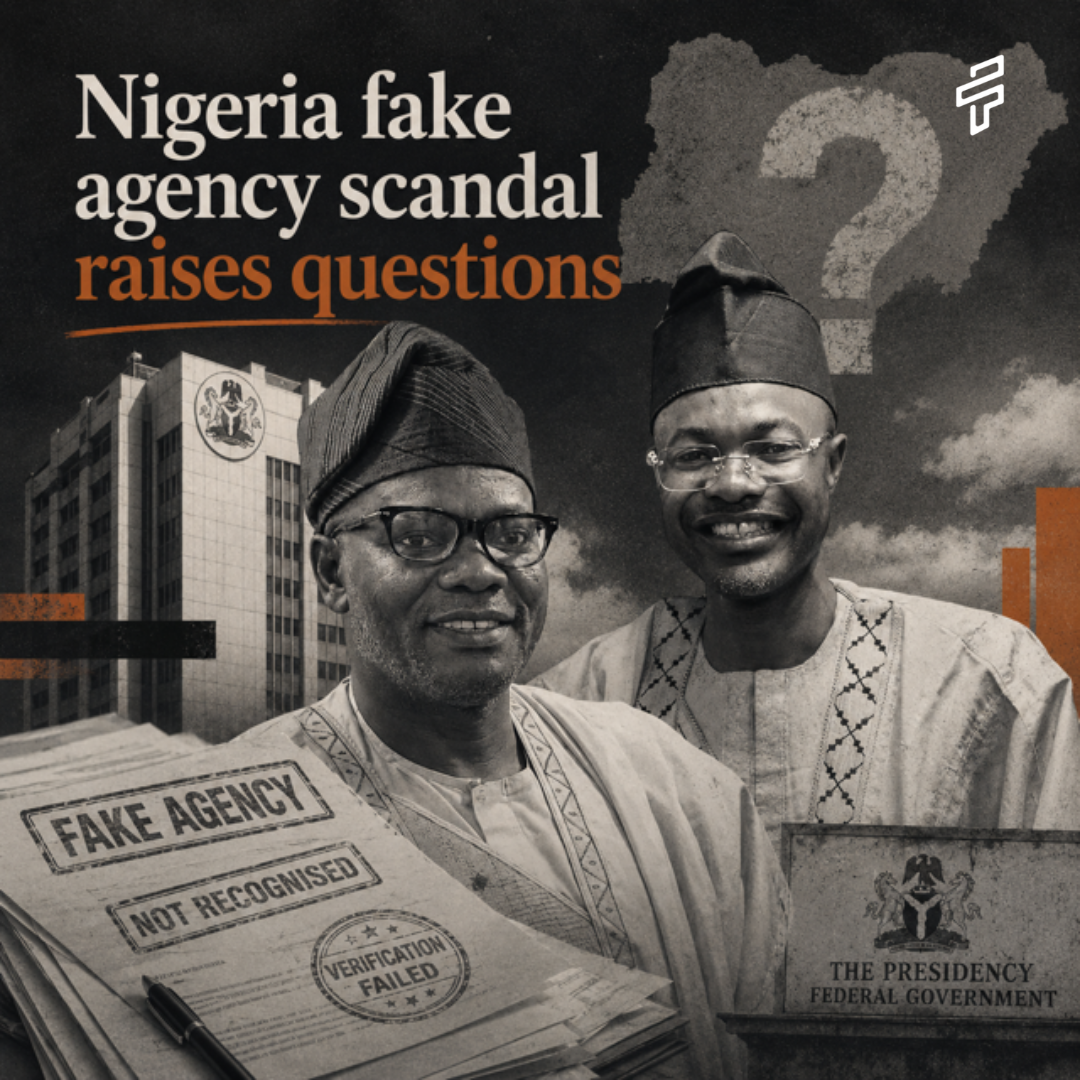
Nigeria’s fake-agency scandal raises questions the government has yet to answer
Nigeria’s latest corruption scandal would almost be comic if its implications were not so serious. An alleged fraudster created a government agency that did not exist, presented himself as its director-general, obtained office space inside the Federal Secretariat in Abuja and interacted with government officials and foreign diplomats. The organisation maintained a government-style website and even appeared in Nigeria’s 2026 federal budget with an allocation of N1.3 billion.
Then investigators found another purported government organisation that did not exist either.
The obvious question is not only how somebody managed to impersonate the Nigerian government. It is how many official doors opened before anyone asked whether the organisation actually existed.
The first entity, the Presidential Foreign Intervention Promotion Council, or PFIPC, had no legal basis, according to investigators. The Tinubu administration says it was never created by law, presidential instrument, executive approval or any other valid government act. Its alleged promoter, Adeniyi Adeyemi, has been charged with offences including forgery and impersonation and denies wrongdoing.
Yet the organisation acquired enough official credibility to operate within the machinery of government. It secured access to federal premises, interacted with public institutions and presented documents that officials treated as legitimate. That progression is more significant than any individual forged document because it suggests that the alleged deception did not have to defeat one major security barrier. It only had to pass through a series of smaller ones.
The question is what created the assumption that PFIPC was genuine. Was it a law, a gazette, a presidential directive or a registry entry? Or was it simply the combination of an official-looking letterhead, a government address and introductions to the right people?
Its appearance in the national budget is perhaps the clearest example. The Budget Office processed the organisation for inclusion in the 2026 budget and an allocation of N1.3 billion was ultimately attached to it. The ICPC has criticised the process, saying the Budget Office did not independently verify the legal instrument supposedly establishing the council.
That raises a basic question about public finance: what does an organisation have to prove before it can receive a budget line?
A legitimate federal agency should have a traceable legal foundation, a defined mandate, a supervising authority, recognised leadership and an accounting structure. Those are the basic markers separating a public institution from a private organisation claiming to represent the state. Yet PFIPC appears to have moved through parts of that system without its underlying legal status being independently established.
The office accommodation is even more revealing. The organisation was able to obtain space inside the Federal Secretariat, one of the most recognisable centres of government administration in Abuja. Once an organisation has a physical office inside a federal building, its appearance of legitimacy becomes much harder for another official to question.
But who authorised that space? What documents were examined? Was its legal status checked before it was given access to government premises, or did the address itself subsequently become part of the evidence that it was a legitimate government body?
The ICPC has recommended administrative action against 13 public officials connected to the affair, including officials linked to the Office of the Head of the Civil Service, the Budget Office and the Office of the Accountant-General of the Federation. The issue is therefore no longer simply whether one individual forged documents. It is whether responsibility for verifying the existence of a government institution was so fragmented that every office could assume somebody else had already checked.
That question became harder to dismiss as an isolated oversight when investigators uncovered another purported agency.
The National Brands Development and Made in Nigeria Special Project Office was allegedly operating within the Office of the Secretary to the Government of the Federation. Authorities say it was headed by George Buchi Nwabueze, for whom an arrest warrant has been issued, while investigators suspect that people inside the OSGF may have assisted the operation. Three permanent secretaries have been suspended.
One fictitious agency might be explained as an unusually elaborate act of impersonation. Two raise a different question: whether Nigeria’s administrative system is too willing to accept institutions that look official.
The problem is not necessarily that every individual official failed to notice something suspicious. It may be that there was no single point in the system where someone was responsible for establishing the complete picture.
One office accepted paperwork. Another processed a request. Another dealt with financial arrangements. Another handled budget information. Each decision may have appeared reasonable in isolation.
But who was responsible for asking whether the organisation itself existed?
That is the institutional vulnerability the scandal exposes.
Nigeria should, in principle, have an authoritative answer to a very simple question: what are the federal government’s agencies? Yet if an organisation can apparently acquire office space, official correspondence, access to senior officials and budgetary recognition without appearing on a definitive central register, the distinction between a genuine institution and a convincing imitation becomes surprisingly fragile.
The implications go beyond the N1.3 billion allocation.
The ICPC says there is no evidence that the money was actually released, cash-backed, paid or spent. It would therefore be wrong to describe the entire allocation as money that was stolen. The more immediate failure occurred earlier: an organisation that investigators say did not legally exist should never have reached the budget in the first place.
That raises questions about the safeguards surrounding Nigeria’s wider public finances. What evidence is required before a proposed agency is entered into the federal budget? Is its establishment instrument checked against an original government record? Is its supervising authority independently contacted? Is it matched against a central register of legally established institutions?
And what role does parliamentary scrutiny play once such an organisation appears in the budget?
Nigeria’s federal budget runs to thousands of pages, making exhaustive scrutiny difficult. But that does not remove the basic responsibility to establish what public bodies are receiving public money. If lawmakers cannot reasonably verify every line, the executive’s administrative systems must be capable of doing so before the document reaches them.
The discovery also raises a more serious security concern. A sophisticated fictitious agency would not necessarily be interested only in money. Once an organisation acquires the appearance of government authority, it could potentially seek access to sensitive information, procurement processes, public-sector personnel, official communications or foreign diplomatic engagements.
That makes the scandal about more than corruption. It is also about institutional security and the credibility of the Nigerian state.
For President Bola Tinubu’s government, the political consequences are delicate. The administration has ordered investigations into both cases, while the ICPC has recommended prosecutions and disciplinary action. That response matters. But it leaves a more uncomfortable question: did the government discover the problem because its safeguards worked, or because the alleged arrangements had already become too visible to ignore?
The government can legitimately argue that it identified the alleged fraud and moved against it. Critics can equally ask why the alleged fraud survived inside the government’s own administrative machinery for so long. Those positions are not mutually exclusive.
What happens next will determine which interpretation carries more weight.
If the government arrests the alleged perpetrators and treats the affair as the work of a few dishonest individuals, it will have addressed the criminal case without necessarily addressing the institutional weakness. A more meaningful response would establish every procedural failure, determine whether officials were deceived, negligent or actively involved, and explain what has changed to prevent the same process from happening again.
Nigeria could also establish a single, publicly searchable register of every legally established federal ministry, department, agency, council and presidential initiative, identifying each institution’s legal foundation, supervising authority and leadership. No organisation should be eligible for inclusion in the federal budget, occupation of government premises or use of official government privileges without a digitally verifiable establishment instrument.
The objective would not be another layer of bureaucracy. It would be making the existing bureaucracy easier to verify.
That matters because Nigeria already has a sprawling administrative landscape of ministries, departments, commissions, councils, authorities and special initiatives. The more complicated that landscape becomes, the easier it is for a fictitious institution to hide behind a plausible name.
The consequences extend beyond government offices. When citizens receive a document from a supposed government agency, apply for a licence or encounter somebody claiming to act for the state, there is a basic assumption underneath the interaction: the government knows which institutions belong to it.
This episode puts that assumption under strain.
The important issue is not the website, the office or the official correspondence individually. It is the sequence of decisions that allowed them to reinforce one another.
Who first accepted the organisation as genuine? Who relied on that decision? Who had the opportunity to challenge it? And why did those questions apparently remain unanswered until investigators intervened?
The discovery of the PFIPC was extraordinary. The discovery of another fictitious organisation makes it harder to dismiss the episode as a one-off act of impersonation.
The government’s next task should therefore be to establish not only who allegedly created these organisations, but which official decisions allowed them to acquire enough credibility to move through the state.
Nigeria needs to know who was supposed to ask the obvious questions, why those questions were not asked and whether the system has now been changed so that the next convincing letterhead cannot become a government agency simply by accumulating official-looking endorsements.
That is what will determine whether this becomes another corruption case or a serious examination of how Nigeria’s institutions recognise authority.
Because the most revealing part of the scandal may not be that somebody allegedly pretended to be the government.
It may be how readily the machinery of government gave that pretence the appearance of fact.