
The Democratic Republic of Congo’s Ebola outbreak is becoming a test of whether the state can still reach its people
The Democratic Republic of Congo is confronting its largest and fastest-growing Ebola outbreak on record, with more than 5,700 confirmed cases and 2,700 deaths. The emergency is unfolding amid insecurity, displacement and a shortage of funding, turning a public-health crisis into a broader test of state capacity.
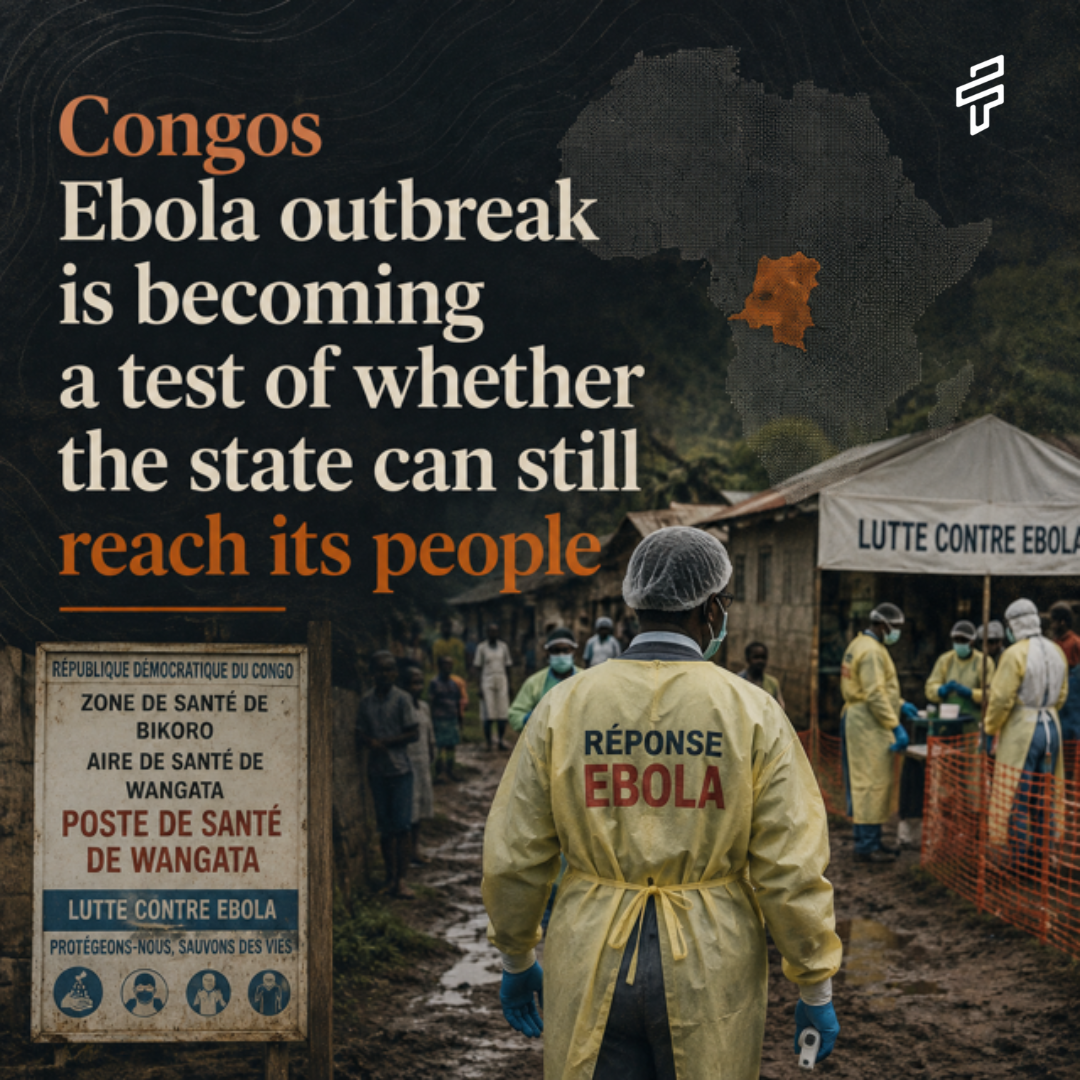
The Democratic Republic of Congo’s Ebola outbreak has entered a dangerous new phase, with almost 5,800 confirmed cases and 2,786 deaths recorded by August 28 as the virus spread across six provinces and 60 health zones. The outbreak is now the largest Ebola emergency Congo has experienced, placing an already overstretched health system under pressure as authorities struggle to contain transmission across a country affected by conflict, displacement and weak infrastructure.
The medical response is accelerating, but it is also entering unfamiliar territory. Congo began administering the Ervebo Ebola vaccine to frontline health workers on August 27, with 70,000 doses authorised by the World Health Organization. Around 50,000 doses are intended primarily for frontline workers, while a further 20,000 will be used in a clinical trial. The complication is that Ervebo is licensed against the Zaire species of Ebola, not the Bundibugyo virus responsible for the current outbreak. Researchers are therefore attempting to determine whether a vaccine developed for another Ebola strain can provide protection while the epidemic is still spreading.
That uncertainty matters because Congo is not confronting Ebola under normal conditions. Health workers have been attacked, medical staff have protested over pay and working conditions, and large numbers of people have been displaced by conflict. The World Health Organization has warned that another $30 million is urgently needed to keep logistics, protective equipment and medical supplies moving. The UN has separately called for an additional $1.1 billion for the wider humanitarian response in Congo. The question is increasingly whether the country can maintain the basic machinery of an effective response while the wider state itself is under pressure.
Congo has more experience with Ebola than almost any other country. The first recognised outbreak was recorded there in 1976, and the country has since developed extensive experience with vaccination, contact tracing, community surveillance and emergency treatment. During the 2018–2020 outbreak in eastern Congo, international organisations and Congolese authorities built some of the most sophisticated Ebola response systems in the world. But the current epidemic is different because Bundibugyo is relatively rare and there is no approved vaccine or specific treatment for the strain.
The scale of the outbreak is also becoming harder to ignore. The WHO has warned that, if transmission continues at its current pace, the epidemic could eventually surpass the 2014–2016 West African Ebola outbreak, which killed more than 11,000 people. That would make Congo’s current crisis one of the most serious Ebola emergencies ever recorded. But the more revealing comparison is with Congo’s own previous outbreaks, when response teams were able to establish treatment centres and surveillance networks around more clearly defined outbreak zones. Today, parts of eastern Congo remain deeply affected by armed conflict, while displacement and population movement make it harder to identify contacts, isolate cases and maintain continuous surveillance.
This is where Ebola becomes a question of state capacity. A government does not control an epidemic simply because its health ministry announces a vaccination campaign. It needs roads to move supplies, laboratories to confirm infections, functioning treatment centres, paid health workers and communities willing to report illness. It also needs enough security for medical teams to reach affected areas. Congo is struggling with several of these requirements at the same time.
The risks are especially serious for healthcare workers. According to WHO reporting, more than 160 health workers have contracted Ebola during the outbreak, with more than 40 deaths. At the same time, hundreds of attacks on healthcare personnel have been recorded in the wider response environment, including attacks resulting in fatalities. Every attack makes the next medical intervention more difficult. Workers become less willing to travel into insecure areas, surveillance becomes weaker and transmission chains that might once have been identified quickly can continue undetected.
The consequences are not purely operational. They are political. In communities that have experienced years of conflict, the state is often an intermittent presence. Police, soldiers, administrators and healthcare workers may be absent, overstretched or distrusted. International organisations can fill some of the gaps, but their ability to deliver a service does not automatically create trust in the institutions responsible for providing it. During an Ebola outbreak, that distinction becomes critical because containment depends on cooperation: people must report symptoms, accept treatment, identify contacts and trust health workers when they arrive.
That creates a difficult cycle for the government. Where institutions are weak, people may delay seeking treatment or avoid contact with officials. Delayed treatment makes outbreaks harder to control, while each new infection increases pressure on already limited medical services. The response then becomes more dependent on international organisations, which can provide resources and expertise but cannot permanently substitute for a functioning national health system.
The financial pressure makes that problem more acute. Congo is facing an Ebola emergency at a time when international humanitarian funding is already stretched by conflicts and crises elsewhere. Donors are being asked to finance Ebola containment alongside displacement, food insecurity and other emergencies across the country. But Ebola is also an epidemic in which delays can be extraordinarily expensive. A laboratory that cannot operate, a treatment centre that lacks protective equipment or a health worker who leaves because wages are delayed can create failures that allow transmission to continue and increase the eventual cost of containment.
There is a potentially important lesson across the border in Uganda. On August 26, the WHO declared Uganda’s own Bundibugyo Ebola outbreak over after 42 days without a new case. The country recorded 20 cases and two deaths. Uganda’s experience demonstrates that the virus can be contained, but it also shows how quickly an outbreak can cross borders in a highly mobile region. The Ugandan outbreak was linked to transmission originating in Congo, reinforcing the importance of border surveillance, information sharing and coordinated response systems between neighbouring states.
The contrast between Uganda and Congo is particularly revealing. Uganda’s outbreak was smaller and more geographically contained. Congo’s epidemic is operating across a much larger territory while facing considerably greater insecurity and displacement. The end of Uganda’s outbreak is therefore encouraging, but it does not reduce the need for preparedness elsewhere in the region. Ebola does not stop at a national boundary, and neither can effective surveillance.
There is also a broader political economy to the international response. External organisations can bring vaccines, money, laboratories and specialised medical expertise, and in the immediate crisis they are indispensable. But the longer Congo depends on outside capacity to perform basic emergency functions, the more important it becomes that the response strengthens domestic institutions rather than bypassing them. A foreign medical team can establish a treatment centre; it cannot permanently replace local health infrastructure. International donors can finance surveillance; they cannot create long-term public trust.
That is the deeper test posed by the outbreak. Congo may eventually contain the virus, but containment alone will not resolve the structural weaknesses exposed by the epidemic. If health facilities remain under-resourced, health workers remain poorly paid, surveillance networks remain fragile and communities continue to experience the state as distant or unreliable, the next outbreak will confront many of the same vulnerabilities.
The next several weeks will therefore be critical. The most important indicators will be whether the growth in new infections begins to slow, whether infections among healthcare workers decline, whether the Ervebo campaign produces evidence that it can protect against Bundibugyo and whether international funding arrives quickly enough to prevent shortages from disrupting the response.
Uganda’s declaration that its outbreak is over is an important sign that containment remains possible. But Congo’s crisis is increasingly about more than the virus itself. It is testing whether the state can deliver protection across a vast and conflict-affected territory, whether communities still trust the institutions attempting to protect them, and whether international partners will provide enough support before an emergency becomes harder and more expensive to contain.
For Congo, the central question is no longer simply whether Ebola can be stopped. It is whether the state can reach the people the virus is reaching.