
The Bukavu school fire exposes the cost of governing a city through a fragile wartime system
At least 24 schoolchildren were killed when a fire swept through schools and nearby homes in Bukavu, a city controlled by the AFC/M23 movement. The tragedy highlights a difficult reality in eastern Congo: controlling territory is not the same as possessing the institutions required to protect the people living there.
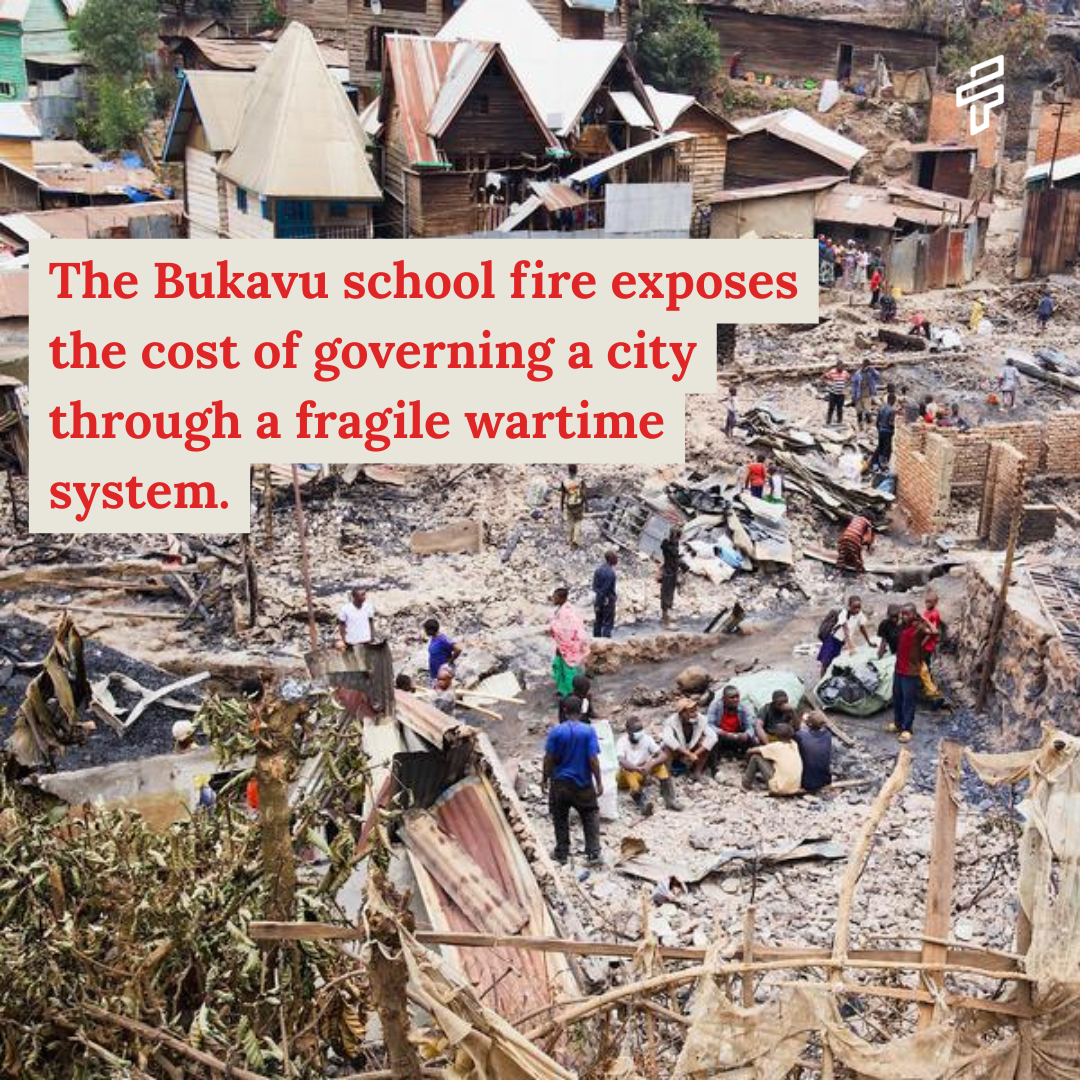
A fire in Bukavu on September 10 killed at least 24 schoolchildren, including 19 girls and five boys, after flames spread through two schools and about 300 wooden homes. The AFC/M23 administration that controls the eastern Congolese city said an investigation had begun, while 29 people were reported injured, including 21 receiving intensive care.
The cause of the fire remains under investigation. What is already clear, however, is the political setting in which the disaster occurred.
Bukavu has been under AFC/M23 control since the movement's offensive in early 2025. The group has sought to present itself not merely as an armed organisation but as an alternative authority capable of administering territory that Kinshasa has struggled to secure.
That claim becomes harder to sustain when measured against the less visible functions of government.
A city is governed not only through checkpoints and security patrols, but through building standards, emergency services, functioning hospitals, accessible roads and the ability to respond rapidly when something goes wrong. Those systems rarely attract attention until they fail.
The destruction of wooden homes and school buildings is particularly significant because dense urban settlements turn relatively contained fires into mass-casualty events. Emergency response then depends on equipment, trained personnel, road access and clear lines of authority. The tragedy raises questions about each of those systems in a city administered by a rebel movement whose political legitimacy remains disputed.
Kinshasa considers M23 an armed rebellion occupying national territory. The United Nations and several Western governments have accused Rwanda of supporting the movement, an allegation Kigali denies. M23, meanwhile, argues that it has imposed greater order in areas where the Congolese state failed.
That competition over legitimacy makes civilian disasters politically important.
If M23 wants to be regarded as a governing authority, its performance cannot ultimately be judged only by whether it can hold territory. It must also demonstrate that schools can operate safely, hospitals can absorb emergencies and authorities can investigate disasters credibly.
The same applies to Kinshasa. Restoring formal sovereignty over eastern Congo would not by itself resolve the governance failures that helped create the opening for armed groups in the first place. Bukavu needs functioning institutions whether the flag over the city belongs to M23 today or the Congolese state tomorrow.
The humanitarian problem is complicated further by the wider crisis in eastern Congo. The country is simultaneously confronting a major Ebola outbreak, placing additional pressure on health systems already operating in a conflict-affected environment. A fire, an epidemic and displacement are not separate emergencies when they compete for the same ambulances, hospitals and health workers.
This is the broader difficulty of governing during war. Weak institutions make emergencies harder to contain; emergencies then further weaken those institutions.
There is also a regional dimension. Eastern Congo's instability affects Rwanda, Uganda and Burundi through population movements, trade and security. The longer parallel authorities operate in major cities such as Bukavu and Goma, the greater the risk that fragmented administration begins to look normal rather than temporary.
For now, the priority is straightforward: support the survivors, determine how the fire began and establish whether preventable safety failures contributed to the death toll.
The deeper question is political. Who is responsible for the welfare of a city when an armed movement controls it but the internationally recognised government does not?